Road Scholar began our Best of Portugal tour in Lisbon. While I couldn’t possibly cover every stop we made, I’ve done my best to share the highlights. Portugal is a beautiful—and often overlooked—country, and we especially enjoyed the sweeping views and the incredible cuisine that defines so much of its charm. After visiting, I’d highly recommend adding Portugal to your travel list.
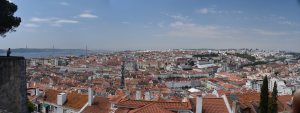
Lisbon, the capital city, is not only the westernmost capital in Europe but also the only one located on the Atlantic. Like much of Europe, Portugal has a layered history—first conquered by the Romans and later by the Muslims in 711—so you’ll see influences from both cultures throughout Lisbon. For the best views of the city, head to either São Jorge Castle, just to the left of the city centre, or the Jardim de São Pedro de Alcântara on the right side. Both offer stunning vistas and are well worth the visit.
If you’re looking for good places to eat, I have two seafood spots to recommend: Ramiro and Marisqueira de Santa Marta. Both were excellent, but Ramiro’s in particular is not to be missed.
As you explore Lisbon, don’t overlook the street art—some of the graffiti around the city is surprisingly thought-provoking and artistic, adding a modern counterpoint to the city’s historic character. Alongside the murals and colorful walls, you’ll also find countless statues and monuments scattered throughout the city. One that stood out to me was the statue of Padre António Vieira, located in the heart of Lisbon. He was a Jesuit missionary, orator, and diplomat who played a major role in both Portuguese and Brazilian history during the 17th century. His presence in the city’s center is a reminder of Portugal’s deep ties to its colonial past and its rich cultural legacy.


Tiles are everywhere in Portugal—it’s one of the things that makes the country so visually distinctive. Even the exteriors of many buildings are covered in beautiful, colourful tiles. Portugal is especially known for azulejo tiles, which date back to the 13th century when the Moors invaded the Iberian Peninsula. The word azulejo comes from Arabic and means “polished stone.” These tiles aren’t just decorative—they tell stories, preserve history, and add a sense of texture to the cities and towns they adorn. King Manuel I played a key role in weaving this art form into the cultural identity of Portugal, helping it become a lasting symbol of the country’s heritage.


One place not to miss in Lisbon is Rossio Square, arguably the liveliest square in the city. It’s a hub of activity, full of locals and tourists alike, and a great spot to soak in the atmosphere. On either side of the square, you’ll find two elegant baroque fountains, and right in the center stands a tall column topped with a statue of Dom Pedro IV, a 19th-century Portuguese king and Brazilian emperor. The square itself is paved with distinctive black and white cobblestones arranged in wave patterns, laid in the 1800s—a beautiful and dizzying detail that gives the ground a sense of movement. On the north side, you’ll see the Dona Maria II National Theatre, a grand neoclassical building constructed in the 1840s. Its stately columns and imposing presence make it a landmark in its own right.


We also happened to be in the right place at the right time—depending on how you look at it—and witnessed a demonstration calling for better funding for schools. It was peaceful, well-organised, and filled with passionate voices. Experiencing something like that reminded me that Lisbon isn’t just about its monuments and history—it’s also a modern city, alive with the everyday concerns and hopes of its people. It was a small moment, but it gave us a glimpse into the local culture in a very real way.


It was also interesting to learn about the Marquês de Pombal, one of the most influential figures in Portugal’s history. His monument stands proudly at the top of a beautiful avenue that stretches through Lisbon, looking out over the city he helped reshape. After the devastating earthquake of 1755, which destroyed much of Lisbon, he was the man tasked with leading the rebuilding efforts. His vision and leadership brought about sweeping reforms—not just in architecture and urban planning, but also in education and the economy. Lisbon’s wide boulevards and structured layout are largely thanks to his influence.


While you’re in Lisbon, you absolutely have to take a side trip to Sintra. If you can spare a full day—or even better, two—it’s well worth it. The town is tucked into the hills and feels like something out of a fairy tale, with palaces, gardens, and forested slopes that seem to whisper history at every turn. One of the highlights is the Castle of the Moors, an ancient hilltop fortress that still stands impressively despite its age. The stone walls wind dramatically along the ridgeline, offering panoramic views of the surrounding landscape. As I stood there, I couldn’t help but think—how did anyone ever attempt to attack this place? The climb alone would be enough to make you reconsider.


Two other highlights in Sintra are the Pena Palace and the Sintra National Palace—both absolutely stunning. Honestly, photos just don’t do them justice. These are the kinds of places you really have to see in person to appreciate—the detail, the color, the dramatic setting. If you can fit them into your Portugal itinerary, don’t hesitate. The views from the hilltops are spectacular, especially looking out over the countryside or catching a glimpse of the National Palace from above.
The Pena Palace has a fascinating history. It began as a small chapel dedicated to Our Lady of Pena, built in the Middle Ages at the top of the hill above Sintra. Later, King Manuel I ordered a monastery to be built on the site, which he donated to the Order of Saint Jerome. But the palace we see today took shape much later—between 1842 and 1854—when King Ferdinand II had the ruins of the monastery transformed into a Romantic-style summer residence. He brought in Lieutenant-General Wilhelm Ludwig von Eschwege, a German engineer and amateur architect, to bring his vision to life. In 1889, the palace was officially purchased by the Portuguese state, and by 1910 it had been classified as a national monument and opened to the public as a museum.


Another must-see in Lisbon is the Castelo de São Jorge. It’s not just the fortifications that make it worth the visit—it’s the view. From the castle walls, you get what is arguably the best panoramic view of Lisbon, stretching out across the red rooftops and down to the Tagus River. It’s the kind of place where you find yourself lingering a little longer than planned, just taking it all in. And while you’re there, keep an eye out for the peacocks—there are plenty of them wandering around the grounds, adding a colorful and slightly surreal touch to the historic setting.


One of our first stops with Road Scholar was a visit to the Royal Palace of Queluz, just outside Sintra. The palace is beautifully preserved, furnished with period furniture and artwork, and is considered one of the last great Rococo buildings designed in Europe. Walking through its grand rooms felt like stepping into another time. We also learned that Peter IV of Portugal—also known as Emperor Pedro I of Brazil—was both born and died in the King’s Bedroom, a detail that added a quiet poignancy to the visit.
After touring the palace, we had some free time to enjoy lunch on our own in Sintra and wander through the town. Though we didn’t have time to tour the Sintra National Palace, we were able to walk around it and take in its impressive exterior. Just being in the heart of Sintra, with its narrow streets and colourful buildings, was a lovely way to spend the afternoon.


No trip to Lisbon would be complete without a visit to the Belém Tower, perhaps the city’s most famous landmark. It rises elegantly from the edge of the Tagus River, almost as if it’s floating on the water. The tower was built between 1514 and 1520 as part of a defensive system to guard the entrance to Lisbon’s harbor and protect the city from seaborne threats. But more than just a fortress, the tower has come to symbolise Portugal’s Age of Discovery, when Portuguese explorers set out to map the world.
The architecture is striking—a blend of Manueline and Moorish styles with intricate stonework and maritime motifs. Today, it’s recognized as a UNESCO World Heritage site, a tribute to Portugal’s seafaring legacy and a must-see for anyone interested in the country’s rich past.


After the Belem Tower visit, we went to see the Jerónimos Monastery which is one of the most prominent examples of the Portuguese Late Gothic Manueline style of architecture in Lisbon. The Manueline style incorporates maritime elements and representations of the discoveries brought from the voyages of Vasco da Gama and Pedro Álvares Cabral.


We proceeded to the National Tile Museum that is dedicated to the azulejo, the traditional tilework of Portugal. The Tile Museum is in the former Madre de Deus Convent and the ceramics collection is one of the largest in the world. Gene, one of our group, comes out of the Tile Museum smiling ear to ear.


A quick side note for anyone planning future travels: if you ever have the chance, go see Cabo da Roca—also known as the Rock of Lisbon. It’s the westernmost point of continental Europe, where rugged cliffs drop straight into the Atlantic and the wind never seems to stop. One of our fellow Road Scholar participants, Robert, leaned casually against the railing, just taking it all in. It’s the kind of place that makes you feel small in the best possible way.


At the end of our journey, we travelled to Porto and the Douro Valley—an unforgettable way to wrap things up. The scenery along the way was breathtaking, with rolling hills, terraced vineyards, and river views that felt like something out of a painting. Before reaching Porto, we made a stop in a walled town—Óbidos, I believe—which was utterly enchanting. Cobbled streets, whitewashed houses with bursts of colour, and a castle that seemed to watch over everything. It felt like stepping back in time, and it added a little extra magic to the trip just when we thought we’d seen it all.


Another unforgettable stop was the Alcobaça Monastery—one of the earliest Cistercian foundations in Portugal. Built in 1153, it was a gift from King Afonso Henriques to Bernard of Clairvaux, commemorating a key victory over the Moors at Santarém. The scale and quiet beauty of the monastery left a real impression, and learning that it’s a UNESCO World Heritage site just added to the sense that we were standing somewhere truly significant. It was a moment where history felt incredibly close, like you could almost hear the footsteps echoing through the stone corridors.


Before visiting Alcobaça, we stayed in Figueira da Foz, a charming seaside town where we spent the night at a lovely hotel right on the coast. The salty breeze and ocean views made it a peaceful stop, but the day ahead was full of local flavor. We visited a traditional salt pan and got a fascinating look into how salt is still harvested using centuries-old methods. We also stopped by a local school to learn about Portugal’s education system—a thoughtful and unexpected part of the program that gave us insight into everyday life. Before leaving town, we strolled through the local market, where stalls were piled high with unbelievably fresh seafood. Yum doesn’t quite cover it.


Our next stop was the University of Coimbra—one of the oldest universities still in operation in the world, and the oldest in Portugal. Originally founded in Lisbon in 1290, it moved permanently to Coimbra in 1537, where it still stands as a symbol of academic tradition and national pride. Before our visit, our Road Scholar group gathered together on the university grounds, taking in the grandeur of the setting. After the tour, we had lunch in town and then enjoyed a Fado performance—haunting, emotional, and very Portuguese. At one point, one of our group members was roped into taking a photo for a couple of visiting tourists. It was a small moment, but it felt like part of the spirit of the day—connection, culture, and the joy of simply being in a beautiful place.


The Douro River region is not only wine country—it’s fantastically picturesque. Truly breathtaking. Terraced vineyards cling to the steep hillsides, and the river winds through it all like something out of a dream. The Douro Valley is the oldest demarcated wine region in the world, dating all the way back to 1756, and grape cultivation here goes back more than 2,000 years. No wonder it’s been recognized as a UNESCO World Heritage Site. One of the highlights was a visit to the Sandeman cellars—part history lesson, part theatrical experience, and a very enjoyable tasting to finish. It was a fitting way to toast the end of a journey that gave us so much to take in—beautiful landscapes, rich history, great food and wine, and meaningful connections.


In Porto, we were struck by the grandeur of the main avenue—broad, bustling, and full of energy.

One of the most memorable stops was São Bento Station, where the tiled walls double as a history lesson. To the left of the entrance, a scene depicts the Battle of Arcos de Valdevez and Egas Moniz before Alfonso VII of Castile. On the right, you’ll find D. João I in Oporto with his fiancée and the Conquest of Ceuta. The detail in the tiles is remarkable—you could easily spend an hour just taking it all in.


Not far from the city, we visited Quinta da Aveleda in the Vinho Verde region. It’s one of the largest wine producers in Portugal and exports more than half of its wine across the world. The gardens at Aveleda were enchanting—not just because of the flowers and foliage, but for the eccentric little buildings tucked around the grounds. And of course, the peacocks. They seemed to know they owned the place. We wrapped up the visit with another tasting, this time of crisp, refreshing Vinho Verde—an ideal way to round off a warm afternoon.


Before leaving Porto, we made sure to visit the harbour and take a boat tour of the Douro River. The views of the city’s famous bridges were stunning, and from the water we caught sight of the Porto Cathedral perched high above the rooftops. We wished for a clearer day, but even under grey skies, the city’s charm was unmistakable. Back on land, we wandered through Porto’s winding streets and popped into the famous Lello Bookstore—an architectural gem and a haven for book lovers—and the striking Church of the Clergymen with its iconic tower. As much as the sights stood out, it was the people who made the trip shine. The many good friends we met along the way truly made Portugal unforgettable.


Looking back, the trip gave us a little bit of everything—wine, history, nature, and the joy of exploring with a group of curious, thoughtful people. The Road Scholar program brought a deeper layer to it all, with guides who made the places come alive and fellow travelers who shared stories and perspectives of their own. It was one of those trips that stays with you—not just for what you saw, but for how it made you feel.
 Marc's Travels